1. Microalgae and its metabolites
1.7 High value products.
On the other hand, some products as PUFAs, SOD or certain carotenoids are worth hundred or even thousands of € a kg and thus require a completely different strategy since product costs become less important while quality and purity become the major issues.
It is not easy to define an strategy to determine what is the best way to process a given microalgal biomass to obtain a given product. Integration is not either a concern and even the product content may be a secondary consideration. For instance, for the production of EPA Phaeodactylum tricornutum may be a better choice than Isochrysis galbana in spite of the latter having mucho more EPA because P. tricornutum does not have DHA which is difficult to separate from EPA.
So, we will just see some conspicuous examples. Asthaxantin from Haematococccus pluvialis and beta carotene from Dunaliela salina are ommited as there are much information that you can find on you own.


Questions and exercises.
-
• Find out about the sources of the long chain poliunsaturated fatty acids (LC-PUFAs) EPA and DHA.
LITERATURE
R. Bermejo, F.G. Acién, M.J. Ibáñez, J.M. Fernández, E. Molina y J.M. Álvarez-Pez. (2003) Preparative purification of B-phycoerythrin from the microalga Porphyridium cruentum by expanded bed adsorption chromatography. Journal of Chromatography B, 790, 317- 325
Cerón MC, Campos I, Sánchez JF, Acién FG, Molina E, Fernández-Sevilla JM. (2008) Recovery of lutein from microalgae biomass: development of a process for Scenedesmus almeriensis biomass. J Agric Food Chem. 2008 Dec 24;56(24):11761-6. doi: 10.1021/jf8025875.
E. Molina Grima, H. Belarbi, F.G. Acien Fernandez, A. Robles Medina, Yusuf Chisti. (2003) Recovery of microalgal biomass and metabolites: process options and economics. Biotechnology Advances 20, 491–515
LC-PUFAs
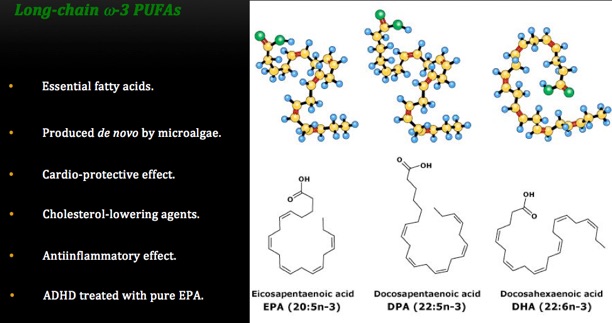
Long Chain Polyunsaturated ω-3 Fatty Acids are believe to be essential nutrients for the humans. This is a matter of debate because the human metabolism can actually produce LC-PUFAs but not a a rate that is enough to keep up to the human body needs.
ω-3 LC-PUFAs are fatty acids with 5 or more insaturations and 20 or more carbon atoms in its hydrocarbon backbone. As for the majority of the natural FAs, the chains are linear (not branched) and all of the double bonds are in a cis configuration. The ω-3 implies that the double bonds are places so that one is found on the third C starting from the “tail” (ω is the last tetter of the greek alphabet).
ω-3 LC-PUFAs play important roles in teh modulation of inflammation and make up a very important part of the fat in the human brain, which is by the way very fatty, containing something line a 50% d.wt. of fat.
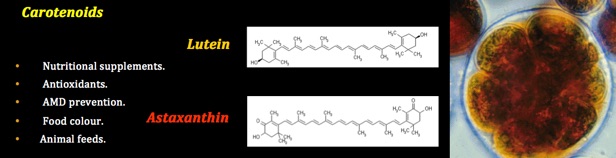
CAROTENOIDS: LUTEIN
Carotenoids from microalgae are a classic. Betacarotene and asthaxantin have been industrially produced from Dunaliela salina and Haematococcus pluvialis (this process is still in full use). This is so because microalgae are very rich is pigments and because they can be stressed to triger the overproduction of these pigments. For instance, Haematococcus can overproduce asthaxantin until the pigment makes up to a 5% of the biomass d.wt.
Betacarotene and asthaxantin are importan food coloring agents. For instance, asthaxantin is the pigment that gives salmon flesh its reddish color. Farmed salmon flesh would be grey without asthaxantin supplementetion.
Lutein is another carotenoid that has gathered increasing attention as it is believed to prevent or ameliorate dry AMD (age-related macular disease). It is the only carotenoid found in a part of the human eye known as “macula lutea” (the most sensitive part of the eye) and is assumed to have a photoprotective effect as it absorbs blue light very efficiently. You can see the structure of lutein below.
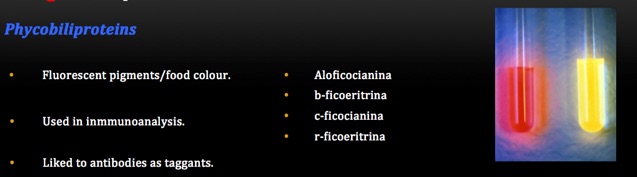
PHYCOBILIPROTEINS: phycoerythrin and phycocyanin
Phycobiliproteins are protein pigments found in the photosynthetic apparatus of microalgae and cyanobacteria. These pigments fluoresce with unique characteristic of spectral purity and quantic yield, so they are very appreciated and widely used as taggants (markers) in inmunoassays. This is, phycolbiliprotein molecules are bound to monoclonal specific antibodies capable of detectinf tumors or whatever by binding to specific antigens. The fluorescence of the ficobiliprotein enables the researchers to detect the marked molecules.

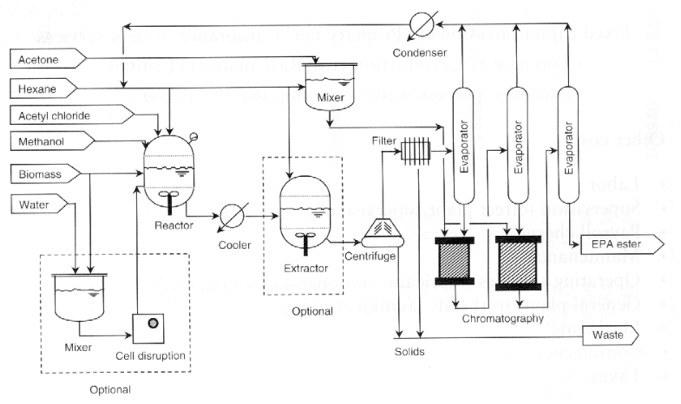
Thus, ω-3 LC-PUFAs are popular nutritional supplements and can be found in may pills and gels and so there is a market for these products and processes for obtaining them from microalgae have been proposed. below, you can see as an example a process to obtain EPA (eicosapentaenoic acid, 20:5ω3) from microalgal biomass.
You can find the details in Molina et al. (2002) but in a nutshell, the process starts with a transesterification that frees all of the fatty acids in the biomass as methyl-esters. These are then extracted from the aqueous reaction phase with hexane, and after purification, the EPA methyl ester is separated from the other PUFAs by chromatography in a column of argentated silica. You can find more information on that separation in the literature.
Lutein is ususlly obteined from the petals of a the flower of “Marigold” (Tajetes sp.) but can also be obtained from microalgae.
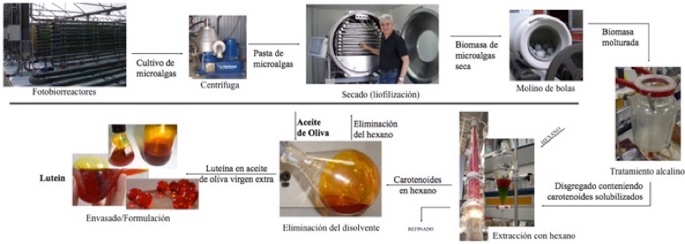
Below is shown a process to obtain lutein from Scenedesmus almeriensis, a microalga that can store up to 1.2% d.wt. lutein in its biomass.
The scheme of the complete process shows that the biomass needs to be stabilized as lutein easily oxidizes. Freeze-drying, an efficient but expensive procedure, is used. This is only feasible for a high-value product. Then the biomass is mechanically broken in a ball mill, lutein is freed in an alkaline treatment with KOH and extracted with hexane. Finally the solvent is eliminated and lutein is transferred to virgin olive oil that has been found to be an excellent excipient both for delivery and stability. You can find the details in the literature below, specifically in Ceron et al. (2008) and Granado et al. (2008).
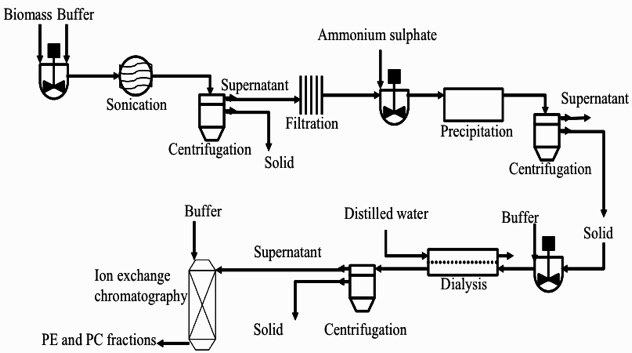
There is a small fut stable and profitable market for those products. Below is shown a process to obtain those colorants from microalgae developed by Bermejo et al (2003).
Protein purification is a rather streamlined process nowadays but Bermejo improved and adapted the process for microalgae. The inclusion of operations as expanded bed chromatography brought about economic advantages by saving in purification steps. You can find the details in Bermejo et al (2003)