1. Microalgae and its metabolites
1.4 Photobioreactors for mass microalgal cultures.
Photobioreactors.
Photobioreactors (PBRs) are the devices used to grow microalgae, usually for biomass productivity but also for research. PBRs can be very large but there are also devices built at bench scale.
The difference between a PBR and a simple lab flask is that the former is equipped with all of the equipment needed for microalgal growth: aeration, stirring and gas exchange, controlled medium supply, pH stabilization, illumination and heat exchange.
There are several types of photobiorreactors. Some are geared towards obtaining a high productivity even at a high economic cost while others make sacrifices in order to keep the costs as low as possible. “Closed” PBRs are the first type while “open” (such as ponds or raceways) belong to the latter. Recently, some low-cost closed PBRs have become available which strike a balance between the two alternatives.


Questions and exercises.
-
• Make a branched scheme classifying the different types of PBRs. Write the main advantage and disadvantage under each PBR in the scheme.
LITERATURE
Open PBRs.
Open PBR represent a design philosophy that advocates low cost and low productivity. The rationale is that since microalgae do not require arable land and light energy (food) is free, there is no need to struggle for high efficiency at a high cost. However, open PBRs have also some disadvantages. We will summarize both next:
Advantages
-
• Low investment
-
• Low operating cost.
-
• Easy operation.
Although the disadvantages seem to overwhelm the advantages, the fact is that something as a 90-95% of the microalgal biomass produced in the world is cultivated in open PBRs. This does not necessarily mean that open PBRs are technically superior as not enough research has currently been done into closed PBRs to suggest otherwise.
Anyway, open PBRs are currently very important and likely so will remain for years to come.
Types of Open PBRs.
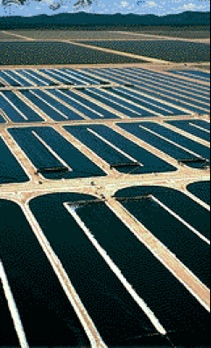
Open PBRs are bodies (layers) of water that are eutrophized in order to promote microalgal growth. There are two types.
Open ponds.
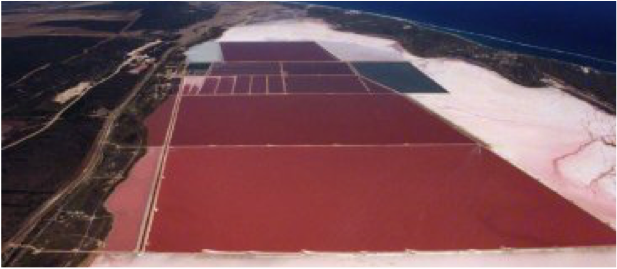
Open ponds are artificial pools of water of a limited depth that are used with the purpose of growing microalgae. Open ponds do not have any kind of stirring or mixing other than te eventual attention of a human curator. The microalgae grow mostly unchecked.
The picture below shows an open pond in which Dunaliela salina is cultivated.
Dunaliela salina has been grown for beta carotene, as it accumulates up to a 5%. This microalgae is an hallophyle that can withstand very high saline concentrations. This keeps other microalgae at bay.
Raceways (or raceway ponds):
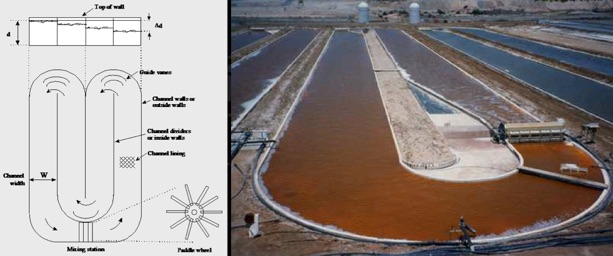
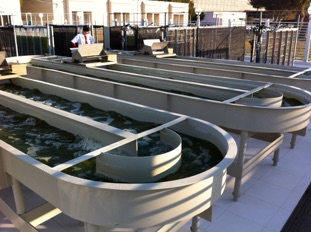
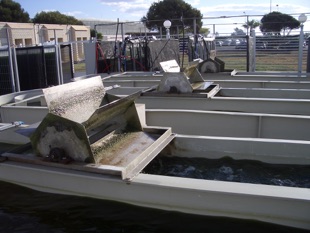
In contrast with the open ponds, raceways are eqquiped with a piece of equipment with the objective of provide movement that causes mixing and thus allows homogeneization and keeping the microalgae suspended.
The most common mixing device is the Paddle Wheel.
Raceways are considerably more productive than open ponds and more stable also. They have the extra operating cost of a impulsing device but the increase in productivity and estability compensates for the extra cost.
Raceways can also be lined or just run over the bare (usually compressed) soil. The use of some kind of lining is an extra cost that improves the quality of the culture and decreases the pumping cost as it reduces the friction of the moving liquid.
Closed PBRs.
Closed PBR are devices that aim to isolate the microalgal strain form the rest of the world and provide a closely controlled environment. The rationale is that under optimal conditions the increase in productivity, quality of the biomas or content in the product od interest can offset the aditional investment and operating costs.
Advantages
-
• High productivity.
-
• Wider choice of species.
-
• Biomass reproducibility.
-
• Optimization of the product content.
-
• Automatization.
-
• Higher biomass concentration: lower harvesting costs.
There are two main classes of closed PBRs. Tubular photobioreactors have to distinct parts, a loop and a degasser. The other type are single-body devices that can take a variety of shapes. We will call the latter “vertical” PBRs as they rely on the aeration to provide mixing and agitation and thus cannot be placed horizontally.
Note: In point of fact there could be vertical, tubular PBRs. I haven’t seen any of these yet but someone among you might come up with one such by the end of this subject.
Even though the addition of a paddle wheel may seem a crude improvement, the availability of a mixing mechanism makes possible a lot more control and the addition of nutrients or even some degree of mass transfer (CO2 supply).
Types of Closed PBRs.
Closed PBRs are relatively water and air-tight devices that enclose a monoalgal culture. Axenic cultures can be done at the lab scale but are very difficult in the large scale.
According to the PBR structure, we have the following types.
Tubular photobioreactors.
Tubular photobiorreactors consist of a loop in which solar light is absorbed for phothosynthesis, and a separate device in which O2 is removed. This is the degasser.
Disadvantages:
-
• Low productivity.
-
• Poor culture control.
-
• Low culture density: high harvesting costs.
-
• Poor mass transfer (gas exchange).
-
• Sensitive to the environment (dirt, rainfall, wildlife)
-
• Only suitable for resistant, fast-growing strains.
-
• Limited strain choice.
Disadvantages:
-
• High investment and operating costs.
-
• Difficoult to build and operate.
-
• Some are difficoult to clean if fouling occurs.
-
• Difficoult to scalate (make bigger facilities).
Vertical photobioreactors.
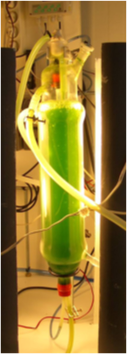
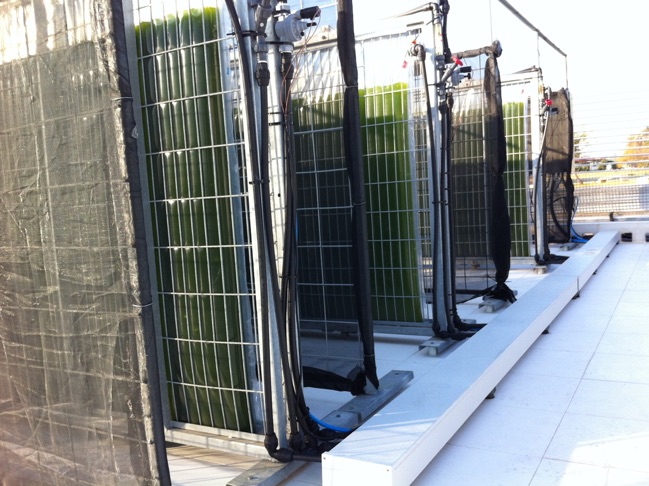
Vertical PBRs are single-bodied culture systems. Light absorption, mixing, heat exchange ... everything happens in the same place. There are two main types: columns and flat PBRs. As a matter of fact, many times flat PBRs are not vertical, bul tilted, in spite of the name of this category.
Column PBRs.
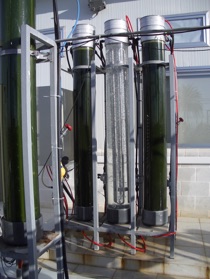
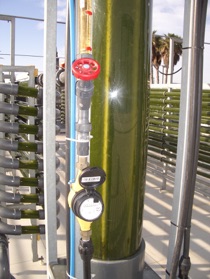
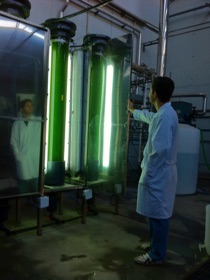
Column PBRs are simple and sturdy. Are easy to build as they do not have moving parts. The draback is that, due to their cylindric shape and vertical position, columns capture little light. In fact, the nearer to the equator a column PBR is placed, the less light it intercepts. And this is worst at noon, when the solar power is the highest.
Columns are also difficult to scalate (make bigger). Even a modest 20 cm diameter is too large a path for light 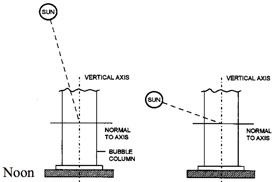 Ito get to the center of the culture. Columns cannot be made very tall either because the pressure at the bottom gets so high as to be harmful for the microalgal cells, specially by the sparger.
Column PBRs are good to eliminate the excess O2, but the CO2 transfer is not very good because of the short contact time of the aeration stream. Only using control it is possible to attain high CO2 transfer efficiencies.
If not for production, columns are great to grow and maintain innocula.
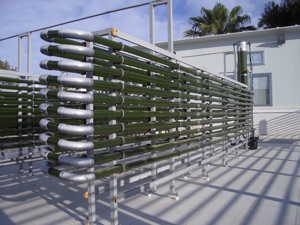
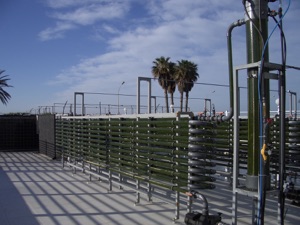
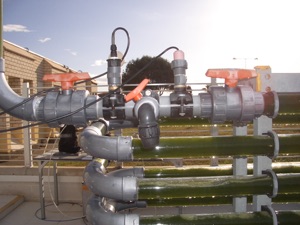
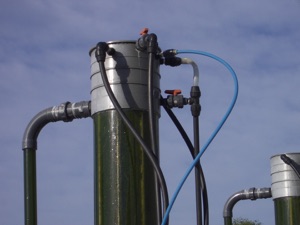
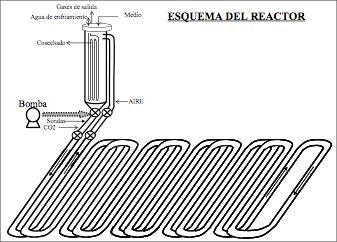
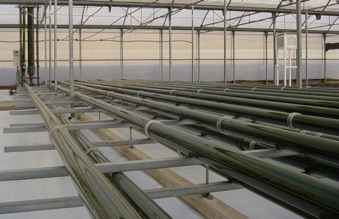
The advantage of tubular photobioreactors is that each of its two parts, loop and degasser, can be designed for maximum performance independently.
The loop diameter, lenght ad culture velocity can be chosen to supply the correct amount of light.
The degasser can be seized accordingly. Heat transfer can also take place in the degasser.
Tubular PBRs need a impulsion device to circulate the culture through the loop. That can be done by means of a mechanical pump (centrífugal, most commonly) or a pneumatic pump or ailift. We will see these in Lesson 5.
Tubular PBRs can be large in size. There are units of several cubic meters. Larger fcilities can be built by putting many units together. There are tubular PBRs (known) of 600 cubic meters.
Flat PBRs.
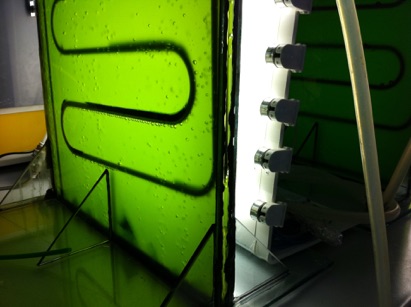
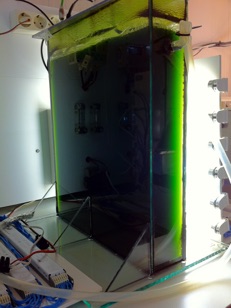
The design of flat PBRs attempts to solve the problems of the collumns while keeping most of its advantages.
For this, flat PBRs give up the cylindric form. The flat form, with a dept usually 5-10 cm, allows for a greatly increased suface-to-volume ratio and thus to a greater light availability.
Flat PBRs are better scaled than columns as they can be done as wide as needed. Stil there is a limit in the height as pressure at the bottom of the PBR is not only a concern because of cell stress, but a great mechanical challenge.