1. Microalgae and its metabolites
1.2 Why should I bother with microalgae?
Photosynthesis is the mainstay of all life on Earth. Photosynthetic organisms provide all the food needed by their heterotropic counterparts. Photosynthesis also provides all the atmospheric oxygen available for respiration. In both cases, microalgae (phytoplankton in general) are major contributors.
Additionally, microalgae are much more productive than higher plants or other pluricelular photosynthetic organisms since they do not have to grow structures or reproductive organs. Thus they a ready to reproduce in a matter of hours. This results in a high specific growth rate and thus a high productivity potential. As microorganism, they do not grow unusable tissues as woody stalks in plants or bone in animals. This is, the produce a rich, higly homogeneous biomass.
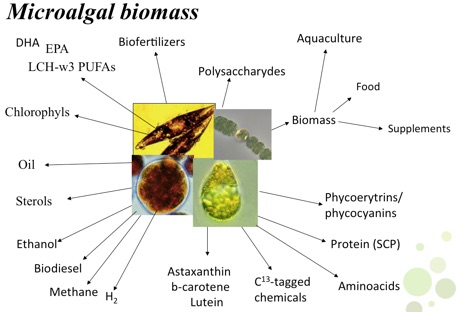
Microalgae have a complex biochemical composition and are a source of highly valuable substances such as carotenoid pigments, poliunsaturated fatty acids, protein and aminoacids and its biomass is a good nutritional source. The use of microalgal biomass in Aquaculture is indispensable.
Questions and exercises.
-
•Find the classification for Haematoccocus pluvialis and Phaeodactylum tricornutum.
-
•Find adequate culture medium recipes for the strains mentioned above.
-
•Find a microalgae that contains EPA (eicosapentaenoic acid).
-
•What is the main distinguishing feature of the genus Anabaena sp.? What does sp. stand for? (hint, this is NOT a microalgae)
-
•Name some species of Anabaena. Find its nutrient needs.
-
•Find what triggers the accumulation of asthaxantin in Haemtococcus pluvialis. Find out what is the main factor triggering lipid accumulation in microalgae.
In short:
-
•Microalgae are photosynthetic microorganisms that produce de-novo a valuable biomass and high -value molecules.
-
•Microalgae are fast-growing organisms (as compared to higher plats and macroalgae) and photosynthetically very efficient.
-
•Microalgae ar the only de-novo producers of several biomolecules (EPA and DHA) and are the sole source of feedstock for some applications as aquaculture (hatcheries an juveniles farming).
-
•The composition of microalgae can be manipulated by some stress factors to overexpress high value compounds such as pigments and antioxidants.
-
•Microalgae produce an homogeneous, reproducible biomass that can be made available all year round with the same composition and at a steady rate.
Aplications of microalge cultures:
Microalge have many applications is diverse fields. Let us summarize some of them.
-
• Feedstock for aquaculture.
-
• Treatment of wastewater with withdrawal od nitrogen and phosphorous.
-
• Renewable production of fertilizers for agriculture (ideally coupled to wastewater treatment)
-
• Production of SCP.
-
• Production of carotenoids such as beta carotene or asthaxantin.
-
• Sustainable production of long-chain PUFAs
-
• Production of phycobiliproteins as dyes and fluorescence taggants.
-
• Abatement of atmospheric CO2.
-
• Production of biofuels.


The potential microalgae have to create large amounts rich, homogeneous biomass while fixing chemical energy from solar light is unmatched by other organisms on Earth.