


Modeling and control of Greenhouse crop growth
Overview
Here, contributions related to the modelling, control and optimization of intensive greenhouse crop production systems are presented. The main objective is to develop accurate and practical modelling approaches that describe the complex interactions between climate, irrigation, crop growth and economic performance, and to exploit these models for simulation, control design and decision support. Research activities address the modelling of key greenhouse subsystems using both first-principles and data-driven approaches, enabling their use in advanced control strategies. Particular attention is given to the regulation of climate-related variables (temperature, humidity, CO₂ concentration) and fertigation-related variables (irrigation scheduling and nutrient concentration), with the aim of ensuring stable crop growth conditions while maximizing productivity and resource-use efficiency. Control strategies include PID and feedforward control schemes widely used in commercial greenhouse platforms, as well as advanced methodologies such as predictive, robust and event-based control. A hierarchical control architecture is considered, where low-level regulatory control is combined with high-level multi-objective optimization. In this framework, optimal reference trajectories for diurnal and nocturnal temperature setpoints, as well as fertigation-related variables such as electrical conductivity, are computed. The overall objectives are to maximize economic profit, improve fruit quality, and enhance water- and energy-use efficiency in compliance with current sustainability regulations. The developed methodologies have been validated using experimental results obtained in industrial greenhouses over several years, demonstrating their applicability under real production conditions.
Facilities
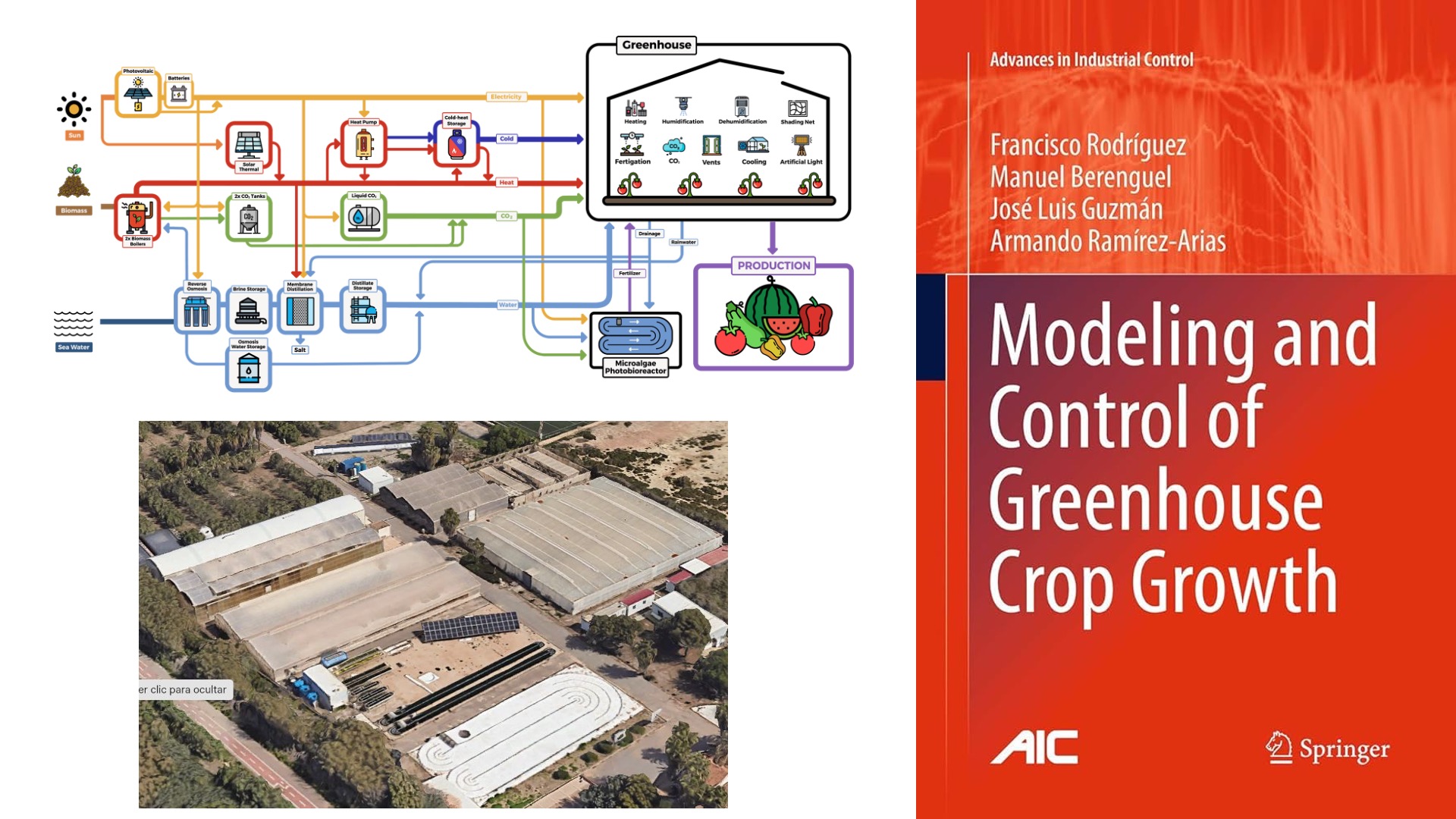
More information: Agroconnect facilities.